A Mother’s Love Turns Into a Fierce Battle for Justice in Kanika Dhillon’s ‘Gandhari’
Taapsee Pannu’s Intense Performance, Strong Character Writing and Devashish Makhija’s Raw Direction Make ‘Gandhari’ a Gripping Watch
There is perhaps no force more powerful than a mother fighting for her child. ‘Gandhari’ takes this timeless idea of motherhood and places it in a dark, contemporary world where helplessness slowly turns into courage and pain into revenge. Written and produced by Kanika Dhillon, the film builds its central conflict around a mother who refuses to accept defeat even when the odds are completely against her.
With Taapsee Pannu leading the film with a deeply intense performance, supported by a strong ensemble cast and Devashish Makhija’s grounded direction, ‘Gandhari’ attempts to deliver an action thriller that is as much about a mother’s emotional battle as it is about her physical fight against a dangerous criminal network. The film is available to stream on Netflix from 3 September. Let’s take a closer look at what works and what doesn’t.
Story:
The story begins with an ordinary family. Bani (Taapsee Pannu) is travelling by train with her husband Gokul (Ishwak Singh) and their little daughter Mishti (Myra Shivaan). Their lives take a horrifying turn at Joypura station in West Bengal when Gokul gets off the train to fetch something, and at that very moment, an unknown woman picks up Mishti and runs away with her.
Desperate to save her daughter, Bani jumps off the train and chases the woman through the crowd. But while running after her, she hits her head against a metal object and collapses, bleeding heavily. The life-threatening accident leaves her eyes severely affected, forcing doctors to bandage them.
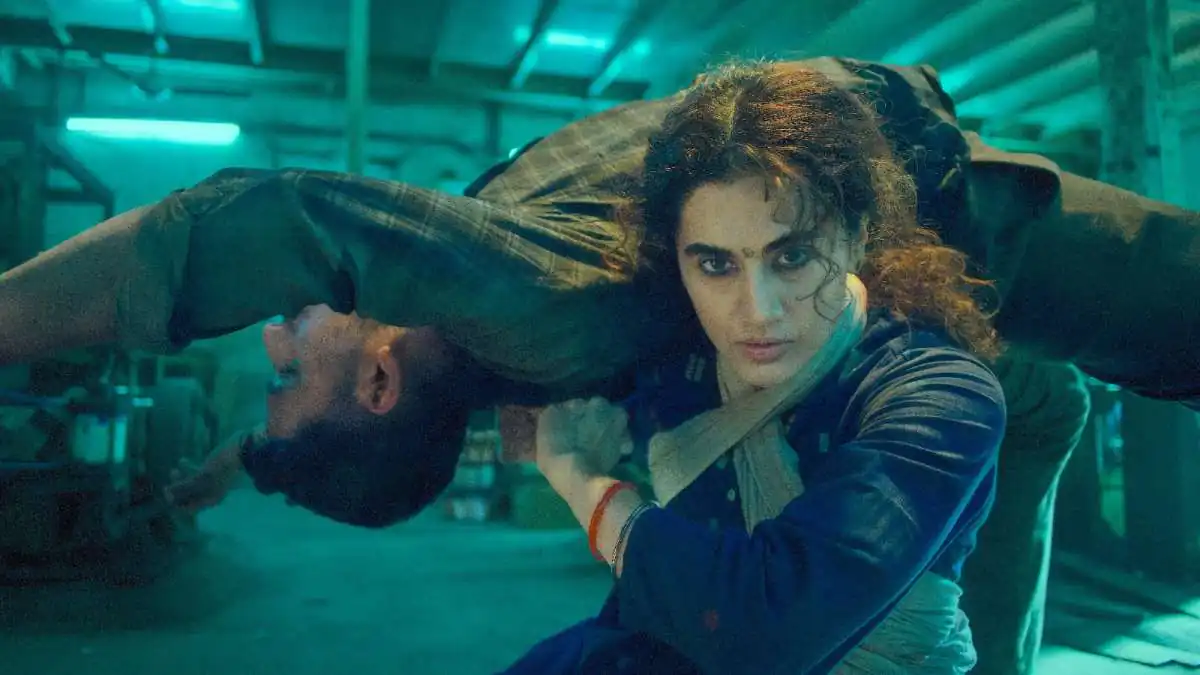
But driven by an obsessive determination to bring her missing daughter back, Bani transforms into a modern-day Gandhari and sets out alone to uncover the hidden monsters of society who have taken her child. The bandage over her eyes, instead of becoming her weakness, becomes a weapon she uses to track down the criminals. She turns her blindness into her greatest strength.
With the police and the system proving helpless, Bani decides to enter the dark underbelly of Joypura herself. Guided only by the bandage over her eyes and the sound of her daughter’s cries echoing in her ears, she manages to enter the terrifying labyrinth of the criminal syndicate.
But will she succeed in eliminating the criminals and bringing her innocent daughter back, or will she meet the same fate as Abhimanyu from the Mahabharata and become a martyr in this battle? You will have to watch the film to find out. However, Kanika Dhillon’s gripping story gives the audience plenty of suspense, action and edge-of-the-seat thrills along the way.
Acting:
Taapsee Pannu is undoubtedly the biggest strength of the film. She once again proves her ability to completely surrender herself to a character written by Kanika Dhillon. As Bani, she has to communicate much of her character’s fear, anger, helplessness and determination without the use of her eyes. Relying on body language, touch, sound and emotional intensity, Taapsee manages to make the character’s inner turmoil visible even when her eyes remain covered.
The transformation of Bani from a vulnerable mother into a fearless woman consumed by the mission to find her daughter is convincing. Taapsee brings both vulnerability and aggression to the character, making her journey one of the film’s most engaging elements.
Ishwak Singh delivers a restrained performance as a helpless yet deeply concerned husband and father. Jatin Sarna effectively captures the stress and dilemma of an honest police officer caught between the system and the reality on the ground. Chhaya Kadam, Swastika Mukherjee and Meeta Vashisht bring experience and gravitas to the supporting roles, adding depth to the film’s dark world. Little Myra Shivaan also leaves an impression with her innocence and natural presence.
Direction and Technical Aspects:
Devashish Makhija keeps the treatment grounded and realistic. His direction avoids turning the film into a loud commercial action entertainer and instead maintains a raw, gritty and somewhat unsettling atmosphere throughout.
Screenplay and Pacing: Kanika Dhillon’s screenplay is one of the film’s stronger aspects. The story gets moving quickly and does not spend too much time setting up the premise. The 1-hour-55-minute runtime works in the film’s favour, keeping the narrative largely tight and ensuring that the momentum does not drop significantly.
The background score and sound design play an important role in creating the film’s atmosphere. Since Bani’s world is built around sound and touch after losing her ability to see, the soundscape becomes an important storytelling tool and effectively adds to the tension.
Conclusion:
‘Gandhari’ works best when it focuses on the emotional power of a mother who refuses to surrender. It combines a revenge-driven narrative with an action thriller setup and gives its protagonist a distinctive challenge by making her fight her enemies without sight.
Kanika Dhillon’s tightly written story, Taapsee Pannu’s committed performance and Devashish Makhija’s raw and realistic treatment come together to create a film that keeps the tension alive. The supporting performances further strengthen the world of the story.
‘Gandhari’ may not reinvent the action-thriller genre, but its strong central character, emotional core and sustained suspense make it an engaging watch. For viewers looking for a dark, intense thriller driven by motherhood, revenge and determination, this Netflix release is worth giving a shot.















.jpg)